
IPTV brand protection is something most new IPTV businesses ignore until it’s too late. Once a brand starts gaining visibility, it also starts attracting attention — including from competitors who try to copy the name, the domain, or the overall identity to take advantage of the traffic and trust that brand has built.
This guide walks through the full process, from choosing a keyword to protecting your brand long-term, so nothing important gets missed.
How to Start an IPTV Business in 2026
1. Start With the Right Keyword
Every IPTV business begins with a single decision: the core keyword. This keyword usually becomes the foundation of the domain name, the brand name, and the overall identity of the website — so it deserves careful thought, not a rushed decision.
Before finalizing a keyword, consider:
- Search volume — is there enough real demand for this term?
- Competition level — how difficult will it be to rank for it?
- Brand potential — can this keyword grow into a recognizable, memorable brand name, or is it just a generic phrase?
A strong choice here saves significant time and cost later, because changing a brand name after launch is far more expensive than choosing carefully at the start.
2. Buy the Right Domain — And Reserve the Related Ones
Once the keyword is finalized, the next step is buying the domain. This is where most IPTV businesses make a costly mistake: they buy only one domain (usually the .com) and stop there.
Here’s the problem: once your brand starts ranking and generating traffic, competitors often notice and register similar domains — a different extension (.tv, .net, .org), a slightly different spelling, or a hyphenated version of the same name. When that happens, two things go wrong:
- Customers get confused about which website is the official one.
- A stronger competitor can use a similar domain to compete directly against you, pulling away traffic and rankings you worked hard to build.
The safer approach is:
- Register your main domain and build your primary website on it.
- Also register the key variations that matter most for your brand — common alternate extensions, close misspellings, and hyphenated versions — even if you don’t plan to use them right away.
- You do not need to launch a separate website on every domain. Simply owning them prevents someone else from using them against you.
This is a small, one-time cost that can prevent much larger problems down the line.
3. Focus All Your Effort on One Main Website
A common misunderstanding is thinking that owning multiple domains means you should build multiple websites. This is not the right strategy.
Search engines and customers both trust one strong, consistent, authoritative website far more than several smaller ones competing against each other for the same keywords. Because of this:
- Put all your SEO effort, content, and backlinks into one primary website.
- Keep the other domains reserved and inactive — they exist purely for protection, not for competing content.
- If your main website ever faces a technical issue, a hosting problem, or another emergency, these reserved domains can also serve as a backup so your business doesn’t lose visibility completely.
4. Build Trust Signals That Are Hard to Copy
Even with domain protection in place, a copycat may still try to imitate your brand’s look and name. This is where trust signals matter — details that are easy for customers (and Google) to notice, but hard for a new, fake website to replicate quickly.
Key trust signals to build from day one:
- Consistent business information — the same brand name, contact details, and support channels across your website, social media, and any directory listings.
- A clear About Us and Contact page — explain who you are, how support works, and how customers can reach you. Copycat sites often leave this page vague or empty, which makes a well-written one stand out.
- Verified, active social media profiles — consistent branding (logo, name, colors) across every platform, updated regularly.
- Genuine customer reviews and support history — real feedback that builds credibility over time and cannot be recreated overnight.
5. Build Long-Term SEO Authority, Not Just Rankings
Many IPTV websites focus only on ranking quickly, but authority is a different — and more durable — asset. Authority is built gradually and is much harder for a competitor to copy than a name or a design:
- Publish original, genuinely useful content on a consistent schedule.
- Build quality backlinks, prioritizing relevance and authority over sheer quantity.
- Maintain a clean internal linking structure so search engines can understand your site clearly.
- Keep up with technical SEO — page speed, mobile performance, and proper indexing — on an ongoing basis.
When these elements work together, copying your brand name alone won’t be enough for a competitor to replicate your results, because the real strength lives in the site’s history and structure, not just its name.
6. What to Do If a Competitor Copies You Anyway
Even with strong preparation, a competitor may still register a similar name or domain at some point. If this happens:
- Clearly state on your official website which domain and channels are the verified, official ones.
- Direct customers to reach you only through your verified social media and support channels.
- Keep investing consistently in content and backlinks — an established, authoritative website naturally continues to earn more trust from both customers and search engines than a newly copied one.
It’s also worth checking, where relevant, whether trademark registration is an option in your target markets. A registered trademark is a separate layer of protection from domain ownership and can give you additional legal standing if someone uses your brand name without permission.
What Happens Without Brand Protection**
To understand why this matters, consider a pattern that has played out with more than one IPTV brand over the past couple of years.
A new IPTV website launches with a strong keyword and a catchy name. The owner works hard on content and SEO, and within 6–8 months, the website is ranking well, generating steady traffic, and building a loyal customer base. Business looks healthy.
But the owner only ever secured the single main domain. No variations were reserved, no trademark was filed, and the brand identity existed only on that one website and a couple of social media pages.
Then, for any number of reasons — the owner moves on to a different project, the domain expires without being renewed, hosting issues pile up, or the business simply gets abandoned — the original website goes offline or stops being maintained.
Because the brand name itself had already built up recognition and search demand, other operators notice the gap. They register a similar domain, copy the branding and layout, and start using the same name to attract the customers who are still searching for it. Since there was no verified secondary domain, no trademark, and no clear “official channel” messaging in place beforehand, there’s little the original owner can do to stop it — the name simply gets taken over by someone else.
The lesson isn’t that ranking well is a mistake — it’s that ranking well without protection creates exactly the kind of valuable, recognizable brand name that others want to take over once it’s left unguarded, even temporarily.
IPTV DMCA Solution: Stop Takedowns & Protect Your Rankings
Example: How Multiple Domains Can Help Protect Your IPTV Brand
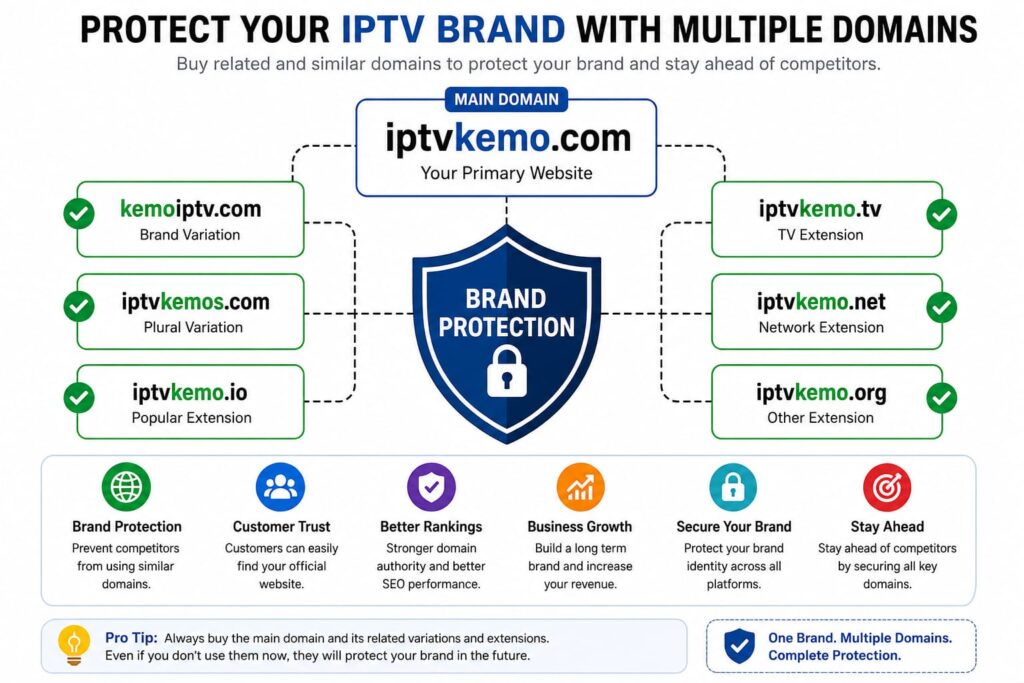
For example, suppose you choose IPTV Kemo as your brand and your main website is iptvkemo.com. Before launching your business, you can consider securing other important and closely related domain variations, such as kemoiptv.com, iptvkemos.com, iptvkemo.tv, iptvkemo.net, and iptvkemo.io, if they are available and make sense for your brand. this is just example for my viewer to understand this process.
You do not need to build a separate website on every domain. Your main domain, iptvkemo.com, should remain your primary website and receive your main SEO, content, and marketing investment. The other domains can simply be reserved and, where appropriate, redirected to your official website.
This creates an additional layer of brand protection. If another company later tries to register a very similar domain, some of the most obvious brand variations may already be under your control. This can also make it easier for customers to recognize which website is your official brand.
For example:
Main website: iptvkemo.com
Protected variations: kemoiptv.com, iptvkemos.com, iptvkemo.tv, iptvkemo.net, iptvkemo.io etc
SEO strategy: Focus your main SEO efforts on iptvkemo.com
Other domains: Keep them reserved or redirect them to the official website when appropriate.
Quick Checklist Before You Launch
- Keyword researched for both search volume and long-term brand potential
- Main domain purchased
- Key domain variations (extensions, misspellings, hyphenated versions) reserved
- One primary website built and focused on
- About Us, Contact, and support information clear and consistent everywhere
- Social media profiles created, branded consistently, and kept active
- Content and backlink strategy planned for the long term
- Trademark registration researched, where applicable
Conclusion
Launching an IPTV brand is more than setting up a single website. It’s a process that combines the right keyword, domain protection, consistent trust signals, and long-term SEO authority. Brands that plan for this from the very beginning find it much easier to handle competition later — because by that point, their brand isn’t just a keyword anymore. It’s an established identity that’s genuinely difficult to copy. if any confusion of custumers just update me and i will guide you every things personaly free.